|
August 16, 2002
The ability to help one understand:
Why Campus Equestrian exists
in the first place!
Many of those reading this column are followers of
the IHSA, even
perhaps members, coaches or alumni. Others are here
seeking
information on riding, riding facilities or other information
under the heading "Equestrian." Campus Equestrian
will provide
information on equestrian happenings for both the knowledgeable
horseperson and those new to the world of riding. However,
in
the early days of this new site, our emphasis will be
on the
Intercollegiate Horse Show Association.
Recently I was asked how I became such a fan of Intercollegiate
riding. It is as simple as the ability to understand
riding
competitions!
If one attends an A, B or C-rated show there is seldom
a printed
program with the entries in it. Unless one is either
a friend,
relative or participant, it becomes very hard to figure
out who
to watch, what the riders are trying to accomplish and,
for the
outsider, what is good riding versus suspect riding.
It was not
long ago that I fell into that last category.
I never got on a horse until I was in my late 20's.
Once I took
a lesson I throughly enjoyed it, and wanted to learn
more. I
went to shows in northern New Jersey to watch my instructor
and
others from where I rode. I was never sure of what division
they were in, what the ribbons meant other than they
could
hang them in their bedrooms, what it cost, etc. Most
importantly, I had no idea how to judge good riding
from suspect
riding, nor what the results went towards. I knew that
the
very best got to ride at the National Horse Show at
seasons'
end, but no one could explain to me how those at Madison
Square
Garden got there in the first place (if you are new
to riding,
the National Horse Show was held at Madison Square Garden
until
recently).
Most local shows I attended were made up mostly of
individuals
in their mid-teens and younger, with adults few and
far
between. All that changed when, on the advice of members
of
the Fordham team (who took lessons at one riding center
I
tried out for a short time), I attended an Intercollegiate
Horse Show for the first time. My alma mater, Fairleigh
Dickinson was hosting at Overpeck Riding Center in Leonia,
NJ.
From the moment I walked in I could tell things were
different. Everyone was of college age or older, as
the IHSA
has something called an alumni division (if you show
one time
as an undergraduate you are eligible to ride as an alumni).
The teams huddled together, cheering mightily when their
riders placed, a far cry from the silence that followed
placings at most local shows. Not knowing what to expect,
I
was stunned to find I could actually talk to the riders
and
coaches, an interactive element unheard of in any other
sport. Most importantly, though FDU had run out of them,
IHSA shows always have programs, with team rosters and
divisions. Some programs even tell you the difference
between each division (the level of difficulty). I became
the FDU fan club, following the knights to shows when
I
could for almost three years. However, if I missed a
show
I would ask those in attendence where I could read about
what happened. I was told that, save for IHSA nationals
and some invitational shows, coverage of regular-season
IHSA
shows is few and far between.
Being somewhat naive about riding periodicals, I refused
to
believe members of the Fairleigh Dickinson and Fordham
teams
when they told me this. After about a year I believed
them.
I thought someone would have the sense to cover these
shows,
but no one did. It seemed no one would, so I gave it
a
shot myself.
In 1994 I put out the only full-length issue of Collegiate
Horse Affair. The January issue, 32 pages long (and
without
any paid advertising), had class-by-class results, a
few
stories, a Spring show schedule that changed radically
after
going to print, a glossy cover, pictures, etc. The IHSA-only
magazine was expensive to produce and I halted then
and there.
One copy found its' way to a woman named Fran Goodzeit,
who
had recently been part of a group who founded SPORTS
CAMPUS,
a college sports web site. In March of 1997, Goodzeit
asked
me if I would join on to cover college riding. After
saying
yes, I spent the next five years updating IHSA information
at
www.sportscampus.com on a part-time basis.
There are many equestrian-related web sites, some with
content
that is unique to that site and many with a series of
links to
other sites. One site links to another, and then another,
and
often a era goes by trying to find something specific.
When
initially covering the IHSA for the SPORTS CAMPUS, I
wanted to
provide results and standings. No one else wanted to
do it,
neither in print nor in the thin air that is the internet.
As
time progressed, many noticed that the information I
was
providing was nowhere else to be found. If you can offer
your
audience something they cannot find elsewhere they will
usually return. People don't want an idea, a concept,
a
theory. They want instant answers. They want results.
Standings. Rankings. Locations. And people want it in
the
least painful, least time-consuming way. Three clicks
and
the answer. Who won? Who moved up?
With Campus Equestrian I have the opportunity to provide
the
same intercollegiate coverage as on the SPORTS CAMPUS,
and
also offer equestrian information outside the relm of
college
riding. We will have information on riding facilities,
horse
care products, equestrian vacations, even results from
some
rated shows. However the IHSA will be our focus to start.
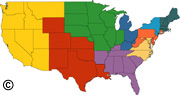
When the black-and-white map on our homepage turns to
nine
colors, the road to each geographical zone within the
IHSA
will be open.
Some years ago, world-renowned trainer George Morris
was
lecturing to an audience. Morris was going on about
the shortcommings of some horse organizations, pointing
out how they did not have a clearly-defined base of
riders
to work with. Morris happened to notice IHSA founder
and executive director Robert E. "Bob" Cacchione
in the
audience. Morris stopped his rant, turned to everyone
and
said "Now there's Bob Cacchione. He has a base
to work with!"
And Morris could not have been more correct. Though
the
college-age population dropped through the eighties
and
much of the ninties, Cacchiones' base of riders nearly
doubled between 1990 and 2002. Now 4,000 riders strong,
the IHSA, started by Cacchione in 1967 as a way for
a few
New York area schools to show against each other, has
survived and become an american equestrian institution.
Campus Equestrian will make it easy to find out when
and
where these IHSA shows are held. And if you get there
early enough, you can get a program, you can find out
who is
entered, who they ride for, what level they ride at.
At most
but not all shows you can follow the team points, posted
and updated, the only paper scoreboard in college sports!
And those involved at the IHSA shows are generally happy
to
clarify information if one cannot understand. I couldn't
agree with their philosophy more.
And that is why Campus Equestrian exists!
Steve Maxwell
Editor-in-Chief
Campus Equestrian
|